


Struggled with IVF/ICSI Multiple Times Without Success?
If you're facing any of these:
- Several embryo transfers, still no pregnancy
- A past miscarriage with no clear cause
- Age 35 or older, and worried about egg/embryo quality
- Concerned about the risk of Down syndrome
These experiences often share one hidden cause that cannot be seen with the eye: an abnormal number of chromosomes in the embryo — something our specialists at SAFE Fertility Group are ready to help you understand.

Why Screen an Embryo's Chromosomes?
Chromosome screening checks whether an embryo has the correct number of chromosomes before it is transferred to the uterus. An embryo with all 46 chromosomes (called a Euploid Embryo) has a much higher chance of implanting and resulting in a successful pregnancy than one with an abnormal chromosome count (an Aneuploid Embryo) — which has too many or too few chromosomes. This can cause IVF to fail, increase the risk of miscarriage, or lead to birth defects such as Down syndrome. This risk increases with maternal age.
Chromosome screening plays an important role in the IVF/ICSI process:
- Selects the strongest embryos, increasing the chance of implantation and reducing early miscarriage
- Helps reduce the number of IVF/ICSI cycles needed — saving time and cost
- Increases the chance of having a healthy baby
- Reduces the future risk of conditions caused by chromosomal abnormalities


Who Is PGT-A Embryo Screening For?
PGT-A is especially recommended if you:
- Are a woman over 35 years old
- Have had recurrent miscarriage (two or more)
- Have had repeated failed embryo transfers
- Want to plan a single embryo transfer to reduce risk
- Have a personal or family history of chromosomal abnormalities
Your doctor will assess suitability individually, based on your history and test results.

Screening Embryo Chromosomes with PGTseq-A from Juno Genetics, USA
PGTseq-A is a chromosome-screening technology developed by Juno Genetics (USA). It uses Targeted Next-Generation Sequencing (tNGS) together with Single Nucleotide Polymorphism (SNP) analysis, delivering more accurate, detailed results — with over 98% accuracy (per Juno Genetics data) — and unlike older methods, does not require whole-genome amplification (WGA) first, which reduces error.
This testing is performed at SAFE Fertility Clinic, in our own genetics laboratory.

Why Choose PGTseq-A?
1. More accurate, for greater confidence
Over 98% accuracy. No WGA, so results are less prone to error — reducing the risk of unnecessarily discarding a good embryo.
2. Reads more detail, for better embryo selection
Detects mosaicism, DNA contamination, and abnormal fertilisation.
3. Fast results, in about one week
Move forward with your treatment plan right away.
How Does PGTseq-A Testing Work?
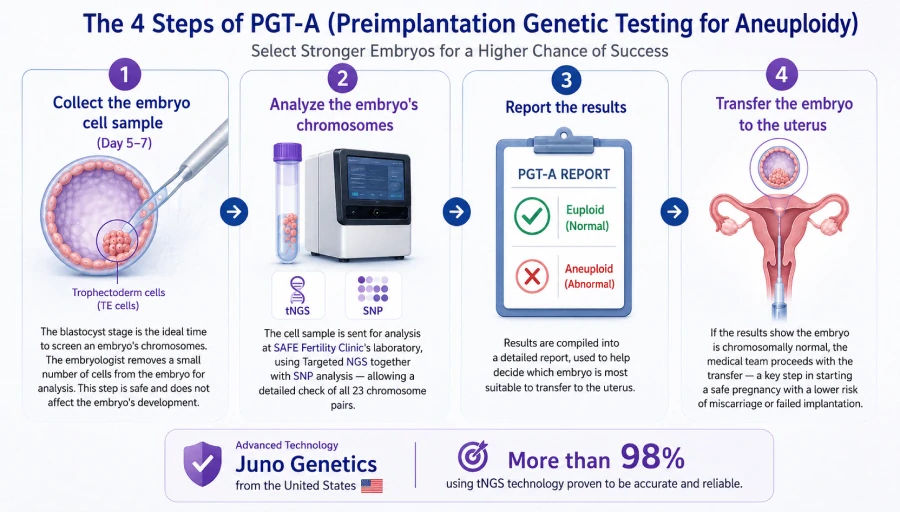
Step 1: Collect the embryo cell sample at the Blastocyst stage (day 5–7)
The blastocyst stage is the ideal time to screen an embryo's chromosomes. The embryologist removes a small number of cells from the embryo for analysis. This step is safe and does not affect the embryo's development.
Step 2: Analyze the embryo's chromosomes for abnormalities
The cell sample is sent for analysis at SAFE Fertility Clinic's laboratory, using Targeted NGS together with SNP analysis — allowing a detailed check of all 23 chromosome pairs, e.g. whether any chromosomes are missing, extra, or otherwise abnormal in ways that could affect implantation, fetal development, or the pregnancy.
Step 3: Report the results
Results are compiled into a detailed report, used to help decide which embryo is most suitable to transfer to the uterus.
Step 4: Transfer the embryo to the uterus
If the results show the embryo is chromosomally normal, the medical team proceeds with the transfer — a key step in starting a safe pregnancy with a lower risk of miscarriage or failed implantation.
Advanced Technology, Higher Success Rates: PGTseq-A (Targeted NGS + SNP) vs PGT-A (Other Platform)
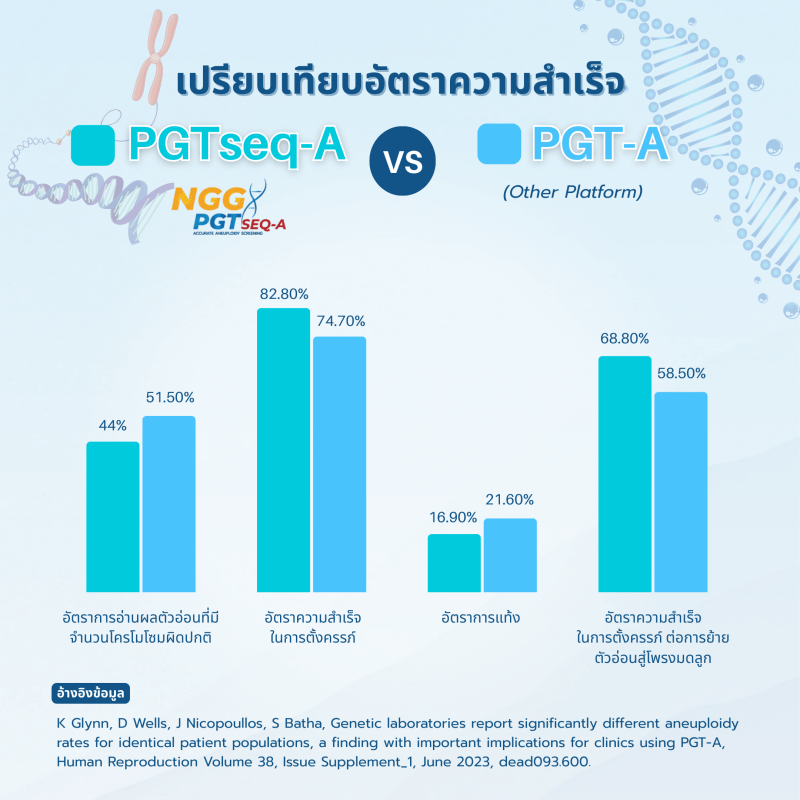 Comparing success rates, PGT-A vs PGTseq-A: pregnancy success 84.3% vs 77.6%, live birth success 75.0% vs 66.0%
From published research comparing PGTseq-A with a general PGT-A (Other Platform) technique:
- PGTseq-A has a “lower” rate of detecting chromosomal abnormalities (aneuploidy) than PGT-A (Other Platform)
- Pregnancy success rate, including success rate per embryo transfer, is “higher” with PGTseq-A than PGT-A (Other Platform)
- PGTseq-A has a “lower” miscarriage rate than PGT-A (Other Platform)
Because PGTseq-A can select embryos more accurately than other PGT-A platforms, it helps couples achieve pregnancy success more often while reducing unnecessary embryo loss.
| Metric | PGT-A (Other Platform) | PGTseq-A |
|---|---|---|
| Rate of embryos testing chromosomally normal | 57.8% | 60.6% |
| Pregnancy success rate | 77.6% | 84.3% |
| Live birth success rate | 66.0% | 75.0% |
Comparing outcomes between PGTseq-A and other PGT-A technologies, PGTseq-A performed better on every metric: the rate of chromosomally normal embryos (60.6% vs 57.8%), pregnancy success rate (84.3% vs 77.6%), and live birth success rate (75.0% vs 66.0%).

What About PGT-A? (FAQ)
PGT-A is the name of the test that screens an embryo's chromosome count. PGTseq-A is the next-generation technology from Juno Genetics that SAFE Fertility Clinic uses to perform PGT-A, giving more detailed results with over 98% accuracy.
A hemorrhage around the scrotum, the infection, however, these conditions are very rare.
No test can guarantee pregnancy at 100%. But it helps increase the chance of success per transfer and lowers the risk of miscarriage from chromosomal abnormalities.
Usually about one week, because SAFE Fertility Clinic runs the test in its own laboratory.