

Understanding Secondary Infertility: Why Having a Second Child Is Hard & How ICSI Can Help
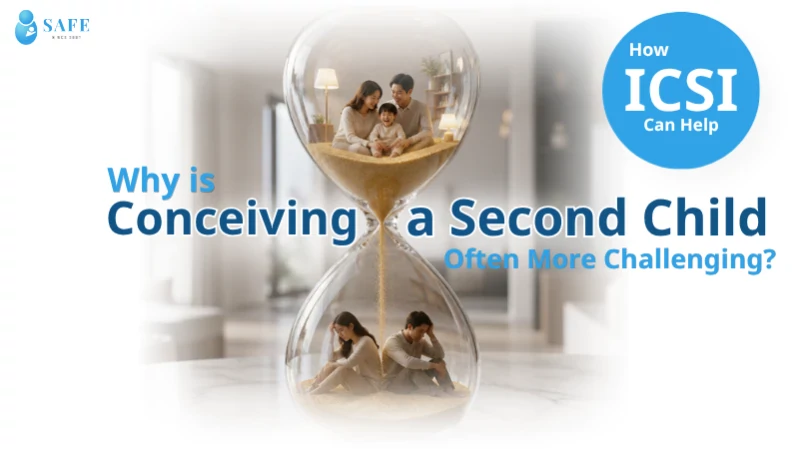
For many families who have already experienced a smooth pregnancy with their first child, there is often an underlying belief that having a second will be just as straightforward. However, as time passes, the journey toward expanding the family doesn’t always go as planned. Many couples try everything—from meticulously tracking ovulation cycles to adopting rigorous wellness routines—only to face constant disappointment. This often leaves them wondering why they are suddenly struggling to conceive when everything seemed perfectly normal before.
In the medical world, this is known as Secondary Infertility—the inability to conceive or carry a pregnancy to term after previously giving birth. It is a surprisingly common situation, particularly among couples looking to have another child after the age of 35. Over time, subtle internal changes take place, including shifting hormone levels, declining reproductive cell quality, and the cumulative impact of stress and modern lifestyle factors. Together, these elements can create unexpected barriers, noticeably reducing the chances of natural conception compared to the past.
When the cycle of waiting begins to take a toll on your emotional well-being, exploring advanced medical options can offer much-needed clarity. Starting with a comprehensive fertility assessment before planning your next pregnancy allows you to identify specific physiological challenges. Advanced reproductive technologies, such as In Vitro Fertilization or Intracytoplasmic Sperm Injection (ICSI/IVF), help eliminate the guesswork, giving you a structured path forward to confidently complete your family.
Why is Conceiving a Second Child Often More Challenging?
The reasons couples experience difficulties when trying for a second child are usually multifaceted. As we age, the reproductive system that once functioned seamlessly may face new biological limitations, primarily driven by the following factors:
1. Declining Egg Quantity and Quality (Ovarian Reserve)
For women planning another pregnancy past the age of 35, both the quantity and quality of remaining eggs naturally decline. This makes natural fertilization more difficult and increases the likelihood of chromosomal irregularities in the embryos, which can unfortunately lead to early pregnancy loss.
2. Changes in Male Fertility
Even if a father has successfully conceived before, changing lifestyles, high stress levels, chronic fatigue, and advancing age can all influence sperm health. These factors can affect sperm motility, morphology, and lead to Sperm DNA Fragmentation—a condition where the genetic material within the sperm is compromised, which can prevent successful conception or contribute to early miscarriage.
3. Complications from Previous Pregnancies or Deliveries
A previous pregnancy or delivery can leave lasting physical changes. For instance, uterine scarring or pelvic adhesions can develop after a prior C-section or birth. Additionally, conditions like endometriosis (chocolate cysts) or uterine fibroids may develop over time, making the uterine environment less receptive to embryo implantation.
4. Underlying Health Conditions
Over time, chronic conditions such as Polycystic Ovary Syndrome (PCOS/PMOS), age-related metabolic shifts, or hormonal imbalances triggered by persistent stress can accumulate, creating noticeable hurdles to conception.
Enhancing Your Second Child Journey with ICSI/IVF
When natural conception does not bring the expected results, assisted reproductive technology (ART) offers a reliable path forward, helping to mitigate the frustration of repeated setbacks. In particular, ICSI/IVF treatments provide a highly focused approach to fertility care. While traditional IVF involves placing eggs and sperm together, ICSI (Intracytoplasmic Sperm Injection) takes it a step further by selecting a single, structurally optimal sperm to be directly injected into the egg.
This ICSI/IVF technique bypasses natural barriers to fertilization, making it highly effective in cases of low sperm count, poor motility, or when the egg's outer shell is too thick for natural penetration. While individual outcomes depend on each couple's unique baseline health, utilizing ICSI/IVF introduces a clear, scientifically guided direction to your family planning.
Refined Screening: Enhancing Confidence with PGTseq-A
To address anxieties surrounding implantation failure or miscarriage—especially for parents navigating pregnancy later in life— ICSI/IVF treatments are frequently paired with advanced screening technologies like PGTseq-A (Preimplantation Genetic Testing for Aneuploidies).
PGTseq-A represents a significant evolution from traditional PGT-A methods that rely on standard Next-Generation Sequencing (NGS). By utilizing Targeted NGS technology, PGTseq-A focuses precisely on critical genetic regions. This targeted approach provides an exceptionally detailed and clear analysis of the embryo’s chromosomal health, covering all 23 pairs of chromosomes, including the autosomes (body chromosomes) and the sex chromosomes (X and Y).
Evaluating the genetic integrity of embryos before they are transferred back into the uterus during the ICSI/IVF cycle helps specialists:
- Identify and select embryos with balanced chromosomal counts.
- Reduce the clinical risk of implantation failure.
- Lower the incidence of early-stage miscarriage, fostering a smoother path toward a healthy, full-term delivery.
Comprehensive International Care for Your Fertility Journey at SAFE Fertility Clinic
Experiencing difficulties when trying for a second child can be deeply disheartening, particularly when your first pregnancy felt so natural. However, as biological and environmental factors evolve over time, traditional methods may no longer be sufficient. For international patients seeking world-class reproductive care, consulting a dedicated fertility specialist for a personalized treatment plan is the first step toward transforming uncertainty into clear, actionable medical insight.
At SAFE Fertility Clinic, we are fully equipped to welcome and support international patients with a seamless, end-to-end medical experience. If you are considering advanced ICSI/IVF in Thailand, our center provides cutting-edge reproductive technologies delivered by highly accomplished fertility specialists and a dedicated team of medical professionals who are well-versed in cross-border patient care.
Supported by our state-of-the-art embryology laboratory, which operates under strict global quality standards, we thoroughly analyze your specific challenges to design a tailored treatment strategy utilizing ICSI/IVF combined with PGTseq-A screening. From your initial remote consultation and international medical coordination to your personalized treatment cycle here in Thailand, our focus is to provide the comprehensive care, clear communication, and optimal opportunities your family needs to welcome its newest member.
Start your journey with us from anywhere in the world. Contact our international patient coordination team at SAFE Fertility Clinic today

Article by: Manop Janthanaphan, M.D. , M.Sc. (Medical License Number: 28364) Obstetrician & Gynecologist, Specialist in Gynecologic Oncology & Minimally Invasive Surgery
SAFE Fertility Clinic, Phuket Branch
Reference:
- คณะแพทยศาสตร์ มหาวิทยาลัยเชียงใหม่ : ภาวะมีบุตรยาก (Infertility)
https://w1.med.cmu.ac.th/obgyn/lessons/infertility/ - Predicted risk factors associated with secondary infertility in women: univariate and multivariate logistic regression analyses
https://pmc.ncbi.nlm.nih.gov/articles/PMC11000415/ - Secondary infertility: causes and treatments
https://www.institutobernabeu.com/en/blog/infertilidad-secundaria-causas-y-tratamientos/ - University of Utah Health : Understanding Secondary Male Infertility
https://healthcare.utah.edu/healthfeed/2024/08/understanding-secondary-male-infertility